
Battle Creek Resident Records Map
Use the narrowest official record that answers the question. A Battle Creek property card can identify the listed owner, tax mailing address, parcel, values, sales, and principal-residence exemption category. It cannot establish who occupies the property. A court result can connect a name variant to a public case, while a vital-record route can verify an event only within Michigan's eligibility rules. The recorder is useful when a property connection needs a dated instrument rather than a current tax field.
| Record route | Best fact to check | Battle Creek or state custodian | Access boundary |
|---|---|---|---|
| Assessor or tax roll | Listed owner, tax mailing address, parcel and value | Battle Creek BS&A and city assessor | Parcel data is public, but it is not occupancy proof |
| Parcel GIS | PIN, address, geometry, zoning and public map context | Battle Creek parcel layer | Owner and taxpayer fields have distinct meanings |
| Recorded instrument | Grantor, grantee, date, document and legal-description clues | Calhoun Official Records Search | Index access is public; image and certified-copy access varies |
| Voter service | Registration status, polling information, ballot and absentee route | Michigan Voter Information Center | Sensitive fields are withheld under Michigan rules |
| Court display | Public case, party-name variant, hearing or status | MiCOURT Case Search | It is not the official file and protected cases are suppressed |
| Vital record | Birth, death, marriage or divorce event | Michigan Vital Records | Copy and verification rules differ by record type and age |
Start with an address when checking a property connection, a case number when checking a court matter, and the event type when seeking a vital record. A name alone deserves extra care. Middle initials, date ranges, printed address periods, parcel PINs, and case numbers help distinguish people with the same surname.
Choose a Battle Creek Record Route
A current address belongs first with the city assessor, county tax route, parcel map, and recorder. Record the exact address spelling, ZIP, PIN, source date, and the difference between the physical parcel address and the tax mailing address. If a name is historical, start with dated directories, newspapers, reverse directories, maps, and archival series instead of treating an old entry as a current location.
A public case calls for MiCOURT and, when needed, the clerk. A birth, death, marriage, or divorce event calls for the Michigan Department of Health and Human Services route. Civic participation is different again: use city boards, ward, or Neighborhood Planning Council material for a public role or meeting record. This sequence avoids asking one system to prove facts held by another.
Record path: address to parcel and tax fields to recorder; historic name to directory and map; case number to MiCOURT and clerk; vital event to MDHHS eligibility review.
Battle Creek's 25,000 Parcel Records
The city assessor says it maintains detailed records for about 25,000 properties. Those records can provide a practical identity check when a name is already tied to a parcel, but they are property administration records. The city parcel layer separates owner names from taxpayer and tax-mailing fields. A mailing recipient may be an agent or another contact, and none of those fields establishes present occupancy.
- PIN
- A parcel identification number, used to carry the same land record across linked assessor, tax, and map sources.
- Situs address
- The physical location of the parcel, rather than the place where tax correspondence is sent.
- Grantor and grantee
- The party transferring an interest and the party receiving it in a recorded instrument.
The Calhoun recorder's quick search accepts grantor or grantee names, subdivision, document type, document number, and recorded-date ranges. Its index was visibly certified through May 11, 2023, a portal certification statement rather than a full archive cutoff. Check the current portal coverage, then follow a legal description, subdivision, lot, or plat if a modern street number has changed.
Note: A parcel result supports a property connection only when its date and field labels fit the question being checked.
Verify Battle Creek Resident Records
Verification means looking for independent facts that agree, not collecting more names. Compare spelling, middle initial, year, address period, occupation in a historic directory, parcel PIN, case number, and source date. A tax mailing address can differ from a parcel address. A directory may be annual and self-reported. A court display may omit protected matters. Each difference can be a useful warning that two records do not identify the same person.
- Write down the exact name variant and the date range that fits the question.
- Use a property or historic-directory record only to establish a dated address or ownership connection.
- Run the public court search with the available name fields or case number, then compare court and time details.
- Use a vital-record verification or certified-copy route only when the event and eligibility rule match the request.
- Docket
- A court's running case record, often showing case events and hearing information rather than every filed document.
- Index and image
- An index is a searchable record list; an image is the scanned document or record page, which may have separate access rules.
- Certified copy
- A copy issued by the custodian with its certification, requested through that office's procedure.
MiCOURT for Battle Creek Records
Michigan's available-courts list identifies Battle Creek 10th District Court and Calhoun Probate Court at the Justice Center, 161 E Michigan Avenue. The district court phone is 269-969-6666, and the probate court phone is 269-969-6794. MiCOURT accepts last name, first name, middle name, birth year, case-number year, case number, and case type. It is a public display, not a substitute for the official court file.
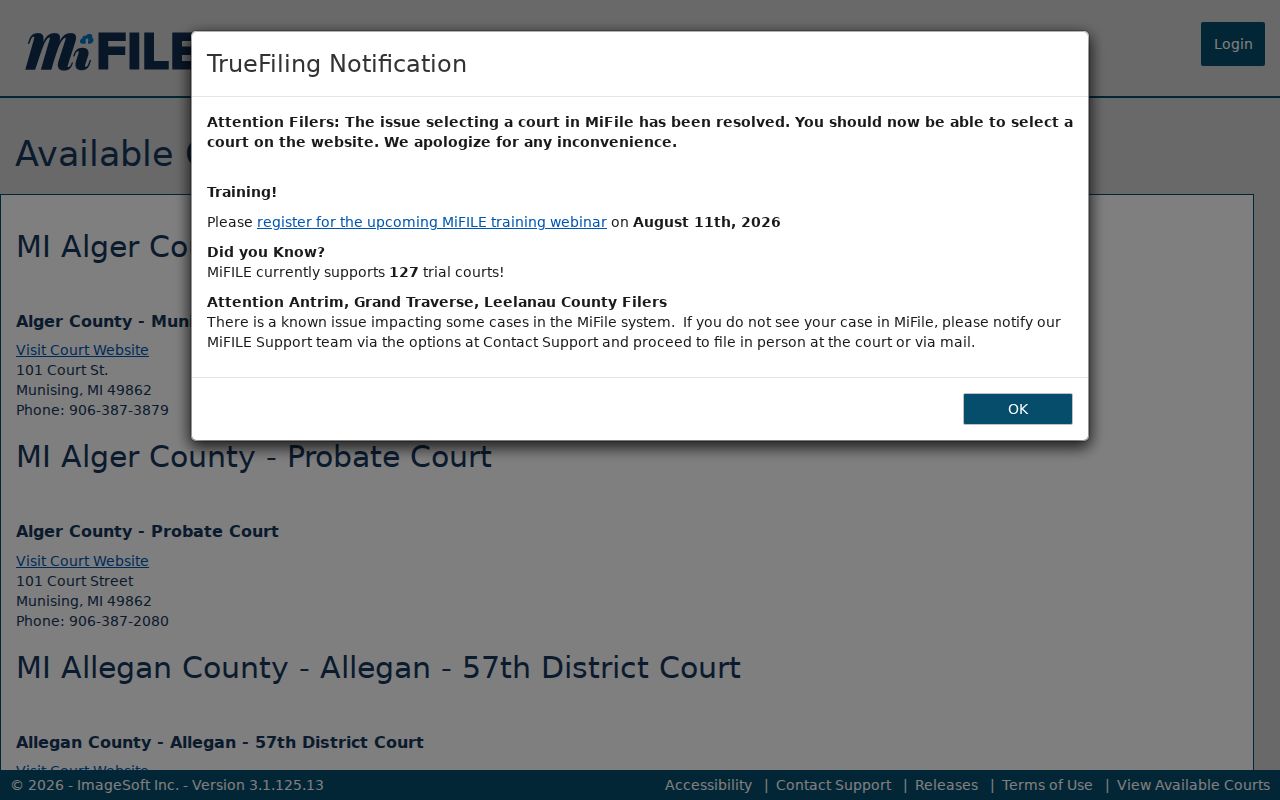
The local listing helps route a case-specific question to the correct court. Adoption, juvenile, sealed, protected, and other nonpublic categories can be absent or limited online. A missing display does not prove that a proceeding never existed. Ask the clerk about public inspection, certified copies, and the correct case number instead of assuming the web result is complete.
| Public docket field | What it may show |
|---|---|
| Case number and party | The case identifier and a public display name |
| CTN | A court tracking number where the display supplies one |
| Hearing details | Date, time, room, location, and hearing information where available |
| Status or disposition | Case-state information when that court and display provide it |
Battle Creek Vital Record Routes
Michigan registration begins in 1867 for births, deaths, and marriages, and in 1897 for divorces. Birth records under 100 years are restricted to the subject and other listed eligible requesters. Records 100 years or older are unrestricted. Death, marriage, and divorce have their own eligibility and verification rules, so a name match does not automatically authorize a certificate.
MDHHS accepts orders by mail, VitalChek, phone, drop box, and scheduled appointment. Its current page reported general processing of about 10 to 12 weeks for regular requests and 8 to 10 weeks for expedited requests at the research date; confirm timing and fees before ordering. The printed birth form has older time estimates, which should not replace the live state page.
For election questions, the Michigan Voter Information Center name route asks for first name, last name, birth month, birth year, and ZIP code. It can provide registration status, polling information, sample ballot, absentee tracking, and clerk links. Driver-license or state-ID number, month and day of birth, phone, email, and internal fields are withheld. Michigan has no party-registration field.
Note: A voter-service response must be matched to the supplied fields and never treated as a general identity record.
Battle Creek Records With No Result
A no-result can mean the wrong spelling, a different time period, a record held by another custodian, or a protected record category. For a historic person, Willard Library's local-history collection offers city directories, newspapers, maps, and archival indexes. Its remote directory portion covers 1890 through 1927 for cardholders, while on-site directories are searchable or viewable from 1923 through 2015. A dated entry can be pursued through the Battle Creek city directory collections before a current-record search is repeated.
State justice tools answer separate, limited questions. OTIS covers prisoners, parolees, probationers under supervision, and people discharged within the past three years. It excludes county jails, city lockups, people held only before sentencing, older discharges, and exempt information. The public sex-offender registry has statutory scope, and ICHAT covers qualifying felony and serious-misdemeanor repository records while excluding federal, tribal, traffic, juvenile, local-misdemeanor, out-of-state, suppressed, and warrant information. Neither a no-result nor an incomplete result supports an inference about a person's history.
No official Calhoun County jail-roster portal was located in the official county sources reviewed. For a specific public record, contact the appropriate court or corrections office, or make a narrow request for an existing nonexempt record. Do not replace that documented gap with an unofficial name list.
Battle Creek Record Request Paths
When an online index stops short, ask the custodian for one existing record series. Battle Creek directs municipal public-record requests through its NextRequest portal; the City Clerk no longer processes those requests. Name the department, record type, date range, address or project identifier, and desired format. The City Attorney's office is the current contact listed on the city FOIA page.
Michigan's Freedom of Information Act, MCL 15.231 et seq., applies to existing nonexempt records, not a new report or a custom person list. Court records follow court rules and clerk procedure instead of ordinary county FOIA. The Calhoun Family Court Plan says public documents may be inspected at clerk offices and existing no-fee documents can be emailed to the circuit-court address. For older deeds, probate, naturalization, or map material, the recorder, Archives of Michigan guide, and library are the appropriate fallback chain.
Lawful Limits for Battle Creek Records
Michigan public records retain their original limits. The Address Confidentiality Program, created by 2020 PA 301 and MCL 780.851 et seq., uses a designated substitute address for eligible participants. Voter applications using that program are confidential. Driver personal information is separately limited by the federal Driver's Privacy Protection Act and MCL 257.208c. Do not infer a move or error from a missing or substitute address.
Keep only the information needed to confirm the record at hand. Do not combine property, voter, court, vital, license, and historic-directory fields into a current private-person file. Michigan's stalking statute, MCL 750.411h, makes repeated unwanted contact and approaching a residence legally significant conduct. Questions about an immediate threat belong with law enforcement or victim-support channels, not a name-check route.
Lawful use. Use Battle Creek record routes for a specific, lawful personal or historical purpose. Never use a result to stalk, harass, intimidate, or harm another person.