
Battle Creek City Directory Collections
Battle Creek city directories survive in several collections, each with a different access rule and an uneven run of years. Willard Library is the central local starting point. Its digitized volumes preserve alphabetic listings, addresses, occupations, and business entries, while the library network provides access beyond the remotely available portion. The table distinguishes a collection from a complete publishing history. An absent year in one catalog means that the consulted collection lacks it, not that Battle Creek had no directory that year.
| Collection | Years | Where Held | Access |
|---|---|---|---|
| Willard digitized city directories | 1890 to 1927 remote portion; 1923 to 2015 on library network | Willard Library and Helen Warner Branch network | Remote with a Willard card for the stated portion; full collection on library computers |
| Willard physical directory collection | 1961 to present, as listed by the local-history collection | Willard Library local history collection | Most local-history material does not circulate; ask staff about use |
| WMU and Google Books directory records | 1880, 1896, 1913, 1918, 1924, 1926, 1929, 1937, 1939, 1945 to 1946, 1949, 1951 to 1952, 1954 to 1963, 1965 to 1966, 1968, 1971 to 1973, 1977 to 1980, 1983, 1985, 1993 to 1995 | WMU Archives and Regional History Collections / Google Books records | Title, OCR, and page access vary by volume |
| Library of Congress criss-cross examples | 1937 to 1938 and 1948 examples | Library of Congress guide | Guide identifies examples; viewing conditions vary |
| Chronicling Battle Creek newspapers | 1846 to 2026 | Willard Library Archives | Pre-1928 public-domain material remote with card; later copyrighted material on-site |
The earliest local directories directly referenced in the research are 1871 to 1872 and 1886. No single official catalog established a universal first or last directory, so those references should not be turned into a claim of uninterrupted coverage.
Note: Record the collection name and access condition, because a title listing alone does not guarantee a viewable Battle Creek volume.
Willard's Battle Creek Directory Archive
The Dean O. Barnum Local History Archive at Willard Library joins city directories with period newspapers, a probate index, historic maps, yearbooks, and local indexes. That combination matters when a listing is brief or an address has changed. The archive also identifies material on local buildings, the cereal industry, the Adventist Church, Sojourner Truth, and the Underground Railroad, which can help a researcher choose useful terms for a catalog or newspaper search.
Willard Library Local History
7 W Van Buren Street, Battle Creek, MI 49017
269-968-8166
Listed hours: Monday through Thursday 9 to 8, Friday 9 to 6, Saturday 9 to 5, Sunday closed. Verify hours before traveling.
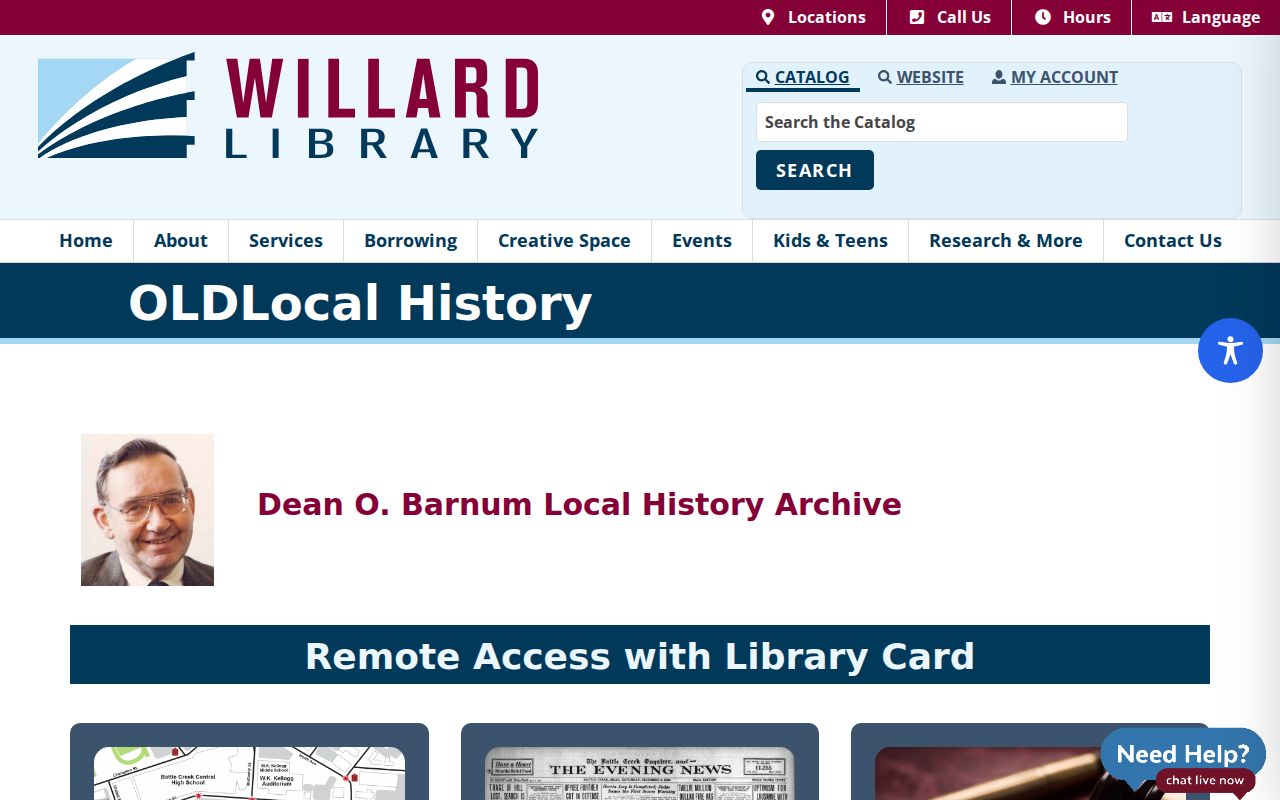
The Willard Library local-history entry point introduces the Battle Creek collection and its access routes.
A visit can connect a printed entry with maps, yearbooks, and archival indexes without treating any one source as a complete household record.
Remote Battle Creek Directory Access
The Willard digitized city-directories collection says that hard copies were removed after use damaged the volumes. Its electronic books are available across the Willard and Helen Warner library network. Cardholders can reach the stated 1890 to 1927 portion remotely. A noncardholder who cannot travel may request a librarian search and an electronic copy. That request route is especially valuable when a particular year or page is known, but it does not make every volume an unrestricted download.
The 1897 Google Books record is associated with the University of Michigan, and the WMU directory collection record identifies additional volumes. Use the access notice on the individual record rather than assuming that a title listing includes full page images.
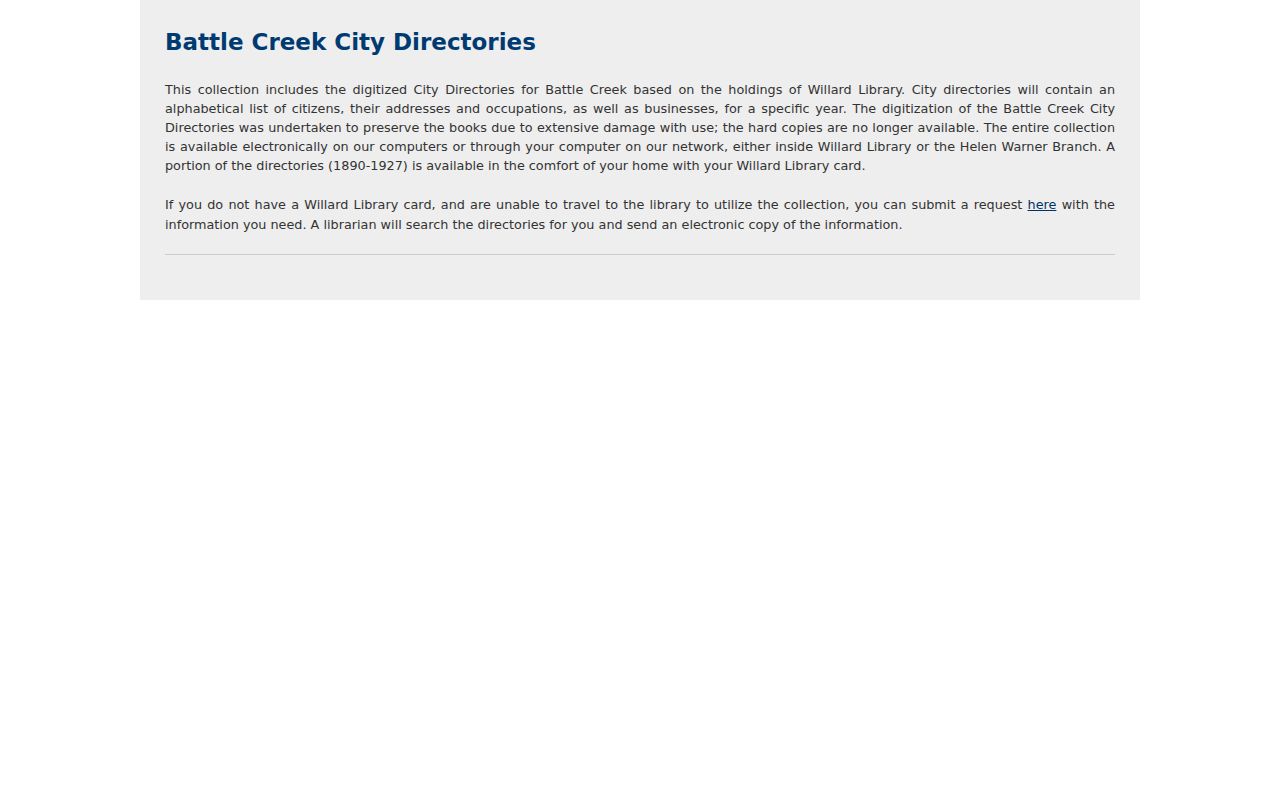
The digitized Battle Creek city-directory collection describes the preserved volumes and their library-network access.
The Historical Society of Battle Creek Archives, at 196 Capital Avenue NE, may be another inquiry point at 269-986-5345. Its public site does not publish a detailed holdings schedule or collection-level finding aid, so contact the society before relying on a particular surname or street search.
Reading Battle Creek Directory Entries
Read each Battle Creek city directory entry as a transcription of what the volume chose to publish for that year. Alphabetic pages can give a name-to-address and occupation snapshot. Business sections can add a firm, proprietor, office address, or trade wording. Capture the entry exactly before expanding abbreviations. The available 1897 metadata and OCR show vocabulary such as bds, bkkpr, carp, mngr, propr, and wid, but the research did not capture a complete public page image that proves a uniform visual layout or every notation.
| Name as printed | Preserve spelling, initials, and any cross-reference rather than silently modernizing them. |
|---|---|
| Address | A period street and number, useful for a dated address trail but not proof of a current location. |
| Occupation or business | A published trade, occupation, firm, proprietor, or office clue when the volume includes it. |
| Entry type | Note whether the entry is an individual, household, firm, institution, or cross-reference. |
| Volume details | Record year, page number, source link or shelf source, and the abbreviation interpretation. |
- Criss-cross directory
- A reverse directory arranged from address or street toward the listed name. It is useful when the address comes first.
- Householder index
- A name-oriented index or entry arrangement that helps start with a household name when the particular volume supplies one.
- Abbreviation key
- The volume’s own explanation of shortened terms. Check it first, or ask a librarian when the key is absent or unclear.
No field should be supplied from guesswork. If a mark or abbreviation changes the meaning of an entry, preserve the uncertainty and seek the volume key, a nearby example, or staff assistance.
Note: Do not expand a directory abbreviation from memory when the volume key or librarian guidance can provide a period-specific reading.
Reverse Battle Creek Directory Searches
A reverse or criss-cross city directory changes the question from “where was this person listed?” to “what was listed at this address?” The Library of Congress criss-cross guide identifies Battle Creek examples for 1937 to 1938 and 1948. Those examples are especially useful for a dated address inquiry, but they should be read as historical publications rather than a list of current occupants.
Street names and numbers can interrupt an otherwise plausible match. Battle Creek’s street-change history includes renamed streets, and the historic-district material links early directories with street-renumbering changes. Search the printed street form as well as the current form, then check a map and nearby directory years. For modern address-keyed sources after the historical trail is settled, use the Battle Creek street directory.
Battle Creek Directory Years
These evidence points show how the available runs overlap. They do not prove that each year was published or that every surviving copy is online.
- 1871 to 1872 and 1886: the NPS historic-district material directly references those local directories and notes street-renumbering changes.
- 1890 to 1927: Willard identifies this as the remote portion for cardholders of its digitized directory collection.
- 1923 to 2015: Willard lists city directories searchable and viewable on-site through its library network.
- 1961 to present: the physical local-history collection separately lists this city-directory run.
A year gap deserves a neutral citation, such as “not located in the consulted collection.” It does not establish that a household vanished or that publication stopped across Battle Creek.
Note: List each missing or unviewable year as a collection gap, not as evidence of a family or publication gap.
Chronicling Battle Creek Newspapers
Willard’s Chronicling Battle Creek project adds a substantial follow-up layer to city-directory work. The project searches nearly 40 local newspapers, about 0.4 million pages, from 1846 through 2026, after a digitization effort the library describes as fourteen years long. A directory address can suggest a date range, business name, or neighborhood term to try in a newspaper search. Newspaper hits still need a source date and should be checked against the directory year and other records.
The project makes pre-1928 public-domain material remotely available to cardholders. Copyrighted material is available on-site at either library or through public Wi-Fi. Willard’s newspaper index spans 1967 through March 2012; its obituary request route is most helpful with an approximate year, and pre-1967 newspaper work also needs one.
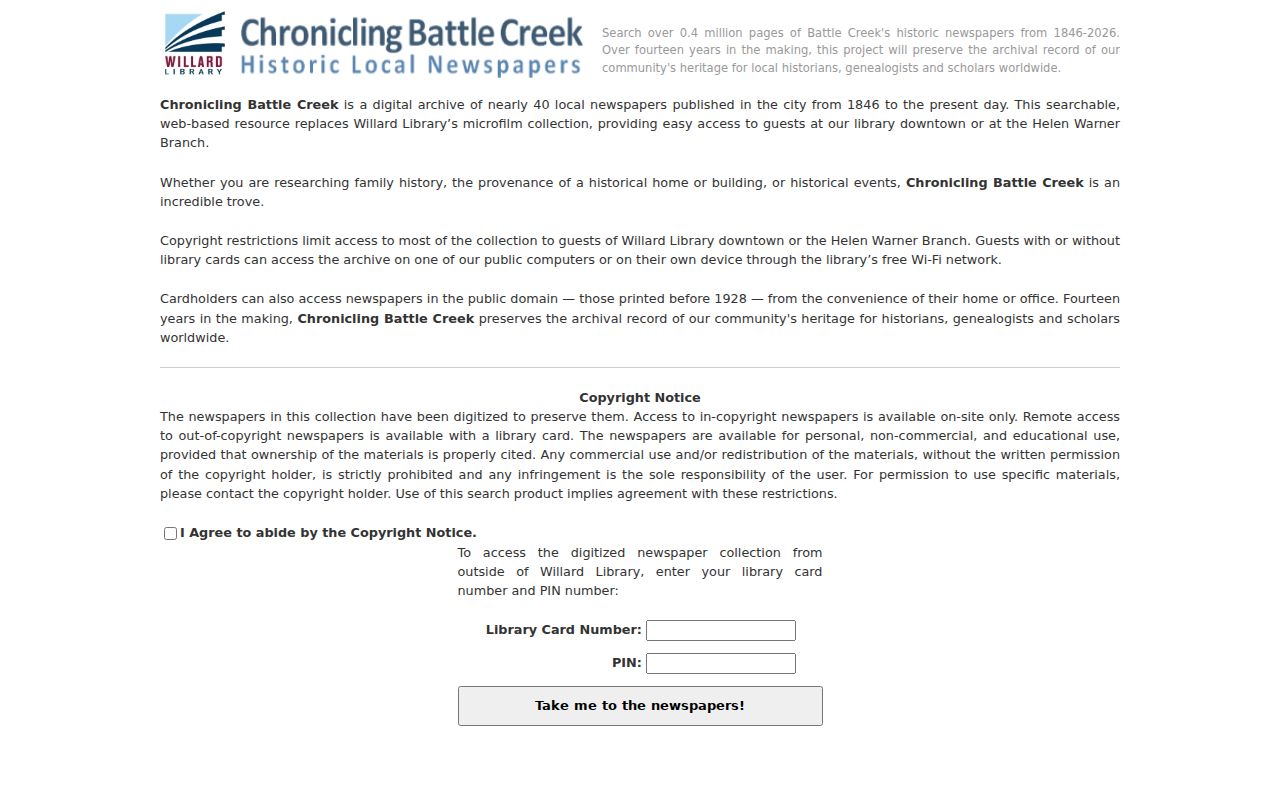
The Chronicling Battle Creek search is the source for this Battle Creek newspaper follow-up route.
Its scale makes the project a local-history story in its own right, but remote access rules still vary by publication date and copyright status.
Trace Battle Creek City Directories
Following a household across city directories works best as a dated chain, not a single-name search. Start with the clearest name variant and capture the exact year and page. Then compare adjacent available volumes, addresses, occupations or business entries, and the presence of similarly named people. A disappearance can reflect a move, death, a changed spelling, an incomplete volume, or a different kind of entry. The trail needs outside evidence before any explanation is preferred.
- Find the first available directory entry and record the printed name, address, trade or business clue, volume, and page.
- Check the next available years, noting each address change and abbreviation rather than assuming it means the same thing in every volume.
- Use a criss-cross volume when an address is the starting point, then compare nearby listings without publishing a compiled current-person list.
- Pair period directories with the appropriate census year, maps, newspapers, or the recorder index to test whether the address trail fits.
- When a person disappears, try the obituary index, cemetery material, probate, naturalization, military, or court series named in the Archives of Michigan Calhoun guide.
The Archives of Michigan Calhoun County guide supplies series-level leads for probate, naturalization, court, land, cemetery, medical, and occupational records. Its series descriptions help test a historical identity without turning a directory entry into proof of a current address.
Battle Creek Directory Trade Clues
Directory business and occupation sections can be read beside Willard’s cereal-industry collection, local biographies, and period newspapers. A firm name or trade phrase may reveal a useful search term for a dated source. Record the year and page every time, and do not infer a continuing affiliation from a single historical listing.
Note: A Battle Creek directory entry records what a publication printed for a particular year, not a person’s present residence, ownership, or legal status.
Citing a Battle Creek Directory
A usable citation keeps the result auditable: title, directory year, page, name as printed, address, occupation or business detail, source location or URL, and the date accessed. Mark whether the entry is a person, household, firm, institution, or cross-reference. When an abbreviation matters, quote the volume key or identify the librarian guidance used to interpret it.
When a later map, newspaper, or parcel record is compared with the listing, cite that source separately and preserve its own date. Separate citations make a gap or disagreement visible instead of hiding it inside a reconstructed story.