
Battle Creek Previous Resident Sources
Previous residents leave different kinds of evidence at different times. Begin with the current parcel and work backward, rather than starting with a surname alone. The current parcel PIN, listed owner, property address, and tax-mailing fields provide a present-day anchor. Recorded instruments can build a title sequence. Dated directories, maps, newspapers, and census schedules add household and building context. None of them should be read as a live list of people at the address.
| Source | Located era or range | Where held | What it contributes |
|---|---|---|---|
| Calhoun official recorder index | Certification visible through 05/11/2023; portal range not located | Official Records Search / recorder | Instrument-index and OCR routes; check current coverage. |
| Early Calhoun deeds | 1833–1843 | FamilySearch catalog, microfilm/DGS | Early deed copies and land transactions. |
| Battle Creek directories | 1871–72 and 1886 references; Willard remote 1890–1927 and on-site 1923–2015 | Willard and related collections | Printed name and address clues for a stated year. |
| Criss-cross directories | 1937–38 and 1948 examples | Library of Congress guide and local collections | Address-to-name entries for selected years. |
| Sanborn maps | 1887, 1892, 1899, 1902, 1907, 1913 | Library of Congress and Willard | Footprint, use, and street context. |
| Homes & Buildings | c. 1940 | Willard Library | Street-organized building image context. |
| Federal census | Released under the 72-year rule | NARA, Census, and library databases | A dated household snapshot, not a current address. |
The recorder’s certification date is a statement about certification displayed on the portal. It is not a proven historical beginning or ending of online records. When an older instrument does not appear, check the index’s current coverage, then use recorder assistance, historic deed materials, or Archives sources rather than declaring the title trail finished.
Build a Battle Creek Address Timeline
Start with a USPS-normalized address and record every version of it exactly as printed. In Battle Creek BS&A and the city parcel layer, capture the present PIN, listed owner, property-address fields, tax-mailing fields, zoning, classification, school district, and source date. The PIN is valuable because it can hold the parcel together when punctuation, directional words, ZIPs, or street numbering vary. The listed owner or tax-mail recipient remains a property-record field, not proof of occupancy.
The Calhoun County GIS landing page is a second public route for parcel and thematic-map context.
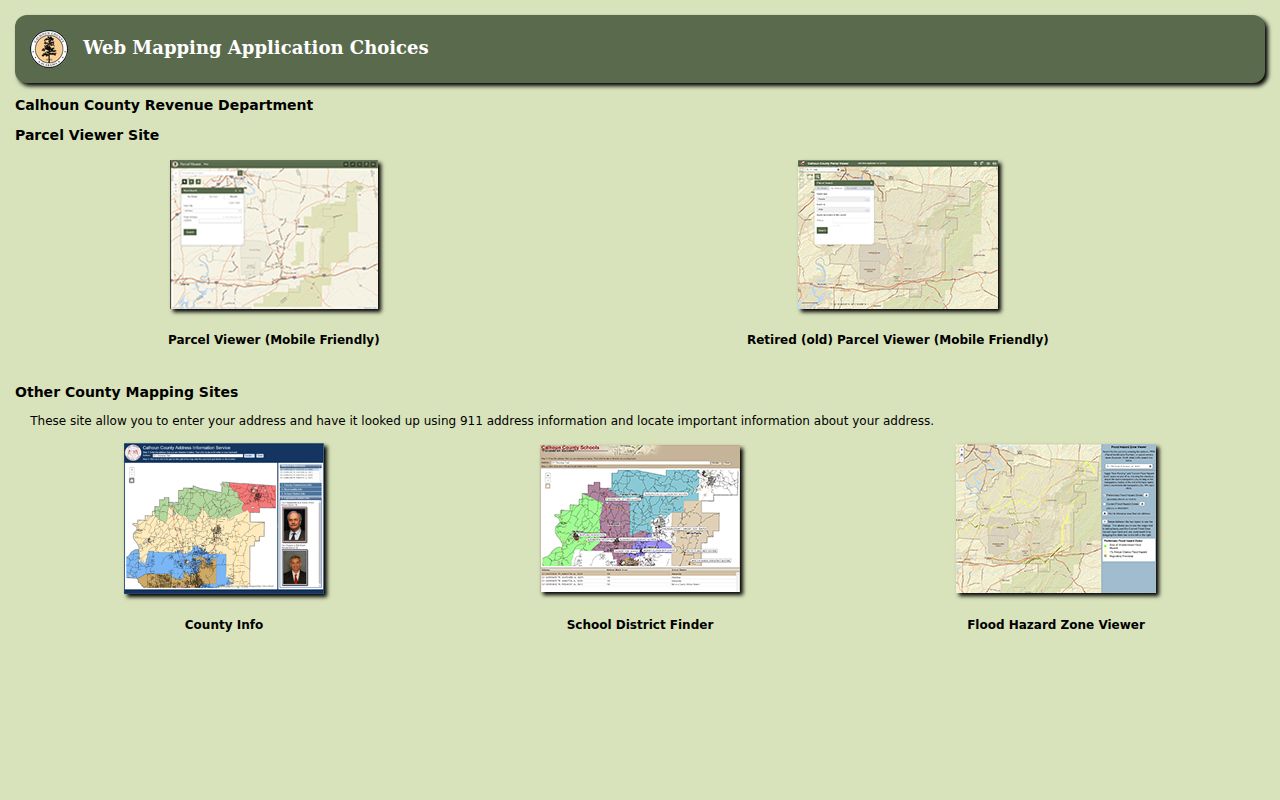
Use the county viewer to confirm the parcel’s mapped setting, then preserve the map date with the address record. Its parcel and thematic-map functions supply geography, not a confirmation of who is currently at the location.
A useful timeline has columns for the address as printed, PIN, owner or taxpayer field, document date, directory year and page, map edition, ZIP result, and source. That compact record makes conflicts visible instead of smoothing them away.
Trace Battle Creek Past Owners
The land trail starts with the current parcel, then follows instruments backward. Search the current listed owner as a grantee in the Calhoun Official Records Search and compare the resulting purchase instrument with the parcel’s legal description. Read the seller named as grantor. That seller becomes the next person to search as a grantee, leading to an earlier purchase. Keep document dates, document numbers, and legal-description language in the timeline at each turn.
- Confirm the current PIN and listed owner in BS&A or GIS, and note the property and tax-mailing distinction.
- Search that owner as grantee, then use the instrument date, type, number, and legal description to isolate the relevant purchase.
- Read the grantor, or seller, on that instrument. Search the seller as an earlier grantee to locate the prior acquisition.
- Repeat the grantee-to-grantor sequence, preserving changes in lot, block, subdivision, plat, or metes-and-bounds wording.
- When the web route runs thin, seek the recorded document or historic series through the recorder, the Archives guide, or the FamilySearch catalog.
- Grantor and grantee
- The grantor transfers an interest; the grantee receives it. Their roles are specific to one recorded instrument.
- Chain of title
- A chronological sequence of recorded instruments that links a parcel’s transfers. It may need reconciliation when instruments or descriptions conflict.
- Legal description
- The lot, block, subdivision, plat, or metes-and-bounds description in a land record. It is often safer than a modern street number for older research.
- Parcel PIN
- The property identifier used by the assessment and GIS systems. It helps connect current parcel records, but it is not itself a deed-chain finding.
When a legal description changes, follow the lot, block, subdivision, plat, or metes-and-bounds language instead of relying only on the modern number. That choice prevents a clean-looking but unsupported match between an old instrument and a present parcel.
Search Calhoun Deeds for Battle Creek Residents
The official index accepts grantor or grantee terms, subdivision, document type, document number, and a recorded-date range. It also offers an index-only search and an index-plus-full-text OCR search. Use the narrower index route first for names and document clues. Use OCR with care when looking for a phrase in scanned material, because OCR can misread a historic name or legal term.
For an older address, search the subdivision or plat when the current street number no longer works. The Recorder and Clerk’s principal office is in Marshall, not Battle Creek, at 315 W Green Street. Ask for the particular instrument, document number, or existing record rather than a custom list of everyone linked to an address. Copy, image, payment, and certification details were not fully captured from the public portal, so confirm the office’s current procedure before relying on it.
Battle Creek Previous Residents in Directories
After the title chain identifies an era, the local directory collections can add a printed household clue. Willard’s digitized directories give remote library-card access for the 1890–1927 portion; the 1923–2015 directory range is available on library computers, and the physical collection also lists directories from 1961 to the present. A person who cannot travel can request a librarian search and electronic copy. The earliest directly referenced Battle Creek directories are 1871–72 and 1886, not a claim of an uninterrupted annual run.
For an address-first search, the Library of Congress guide identifies Battle Creek criss-cross examples from 1937–38 and 1948. Compare a printed entry with the volume year, page, address form, and any abbreviation key. The broader collection details and how to read an entry belong with the Battle Creek city directory collections; here, use one dated entry only as a stop in a single-address backward trail.
Pair Battle Creek Addresses and Census
Directories and census schedules work well as paired dates, but they answer different questions. A directory can supply a printed address in a particular publication year. A released census is a household snapshot subject to the federal 72-year rule. Neither one independently proves every day of residence or ownership. Begin with a directory year near the period of interest, then choose the nearest available released census and compare the address, name spelling, household relationships, and map context.
- Write down the directory’s year, page, and exact address wording.
- Check whether a criss-cross edition exists for the same address or nearby year.
- Locate the closest released census period and record its enumeration context with the source date.
- Use deeds, Sanborn sheets, and street-change evidence to test whether the historic address maps to the same parcel.
When the names do not match, do not force a conclusion. A directory can be annual and self-reported, while the census uses a different date and process. Preserve the disagreement and seek a recorded instrument, newspaper item, probate calendar, cemetery record, or Archives series appropriate to the period.
Battle Creek Addresses Before Renumbering
Street continuity is a local research problem, not a cosmetic detail. National Register material for the Battle Creek Downtown Historic District references the 1871–72 and 1886 directories and notes street-renumbering changes. The city’s renaming process also involves the Assessor, GIS, Code Compliance, Building Inspection, Historical Society, utilities, telecommunications, and USPS or parcel delivery. A renamed or renumbered street can appear differently in a deed, tax card, map, newspaper, voting reference, and directory.
Search the old and new street names, then compare landmarks and adjacent blocks. The Library of Congress has Battle Creek Sanborn editions for 1887, 1892, 1899, 1902, 1907, and 1913. If several parcels remain plausible, state that uncertainty rather than assigning a former resident to a modern address.
Map a Battle Creek Address Backward
Maps and images supply the building layer of a previous-resident search. Sanborn sheets can show a dated footprint, use, street label, and nearby landmarks. Willard’s historic-map holdings extend through the period it identifies, and its street-organized Battle Creek Homes & Buildings, c. 1940 catalog can be compared with a 1937–38 criss-cross directory, a relevant directory entry, and the current parcel card. That comparison can reveal a numbering change, alteration, business conversion, or neighborhood change without turning a historic image into a present-day claim.
The Historical Society of Battle Creek operates the Battle Creek Archives and is another local-history contact point.
The society’s public site does not publish a complete holdings inventory. Contact the Archives before travel for its current finding aids, access timing, fees, and street or surname research availability.
Battle Creek Past Residents in Newspapers
Willard’s Chronicling Battle Creek project searches nearly 40 local newspapers from 1846 through 2026, totaling more than 0.4 million pages. Pre-1928 public-domain material is remotely available with a library card. In-copyright material is available on-site at either library or through public Wi-Fi. The library also has a newspaper index from 1967 through March 2012 and an obituary-request route when an approximate year is known. Treat a newspaper item as a dated clue that needs cross-checking.
When the address trail ends with an estate, death, departure, or long gap, the Archives of Michigan Calhoun guide can point to probate, naturalization, court, land, military, cemetery, and professional-record series. The Historical Society’s Battle Creek Archives is at 196 Capital Avenue NE. Its web inventory is limited, so a call or email is the appropriate next step for collection-level questions.
Privacy Limits for Battle Creek Previous Residents
Historic research should stay historic. An old directory or newspaper entry is not a current address, and a current parcel-owner field is not proof that a named person lives at the property. Do not combine old and current records into a profile of living people. Michigan protects driver-record personal information, and the Address Confidentiality Program can use a substitute address in public-facing government records for eligible participants.
Use the trail for family history, property history, estate research, or a narrowly defined public-record question. Keep each source’s date and purpose beside the finding, and leave protected, sealed, juvenile, victim, and confidential information alone.
Lawful use. Battle Creek previous-resident research is for careful historical and personal records work. Michigan stalking law, MCL 750.411h, makes repeated unwanted contact and approaching a residence legally significant; never use these sources to stalk, harass, intimidate, or harm anyone.